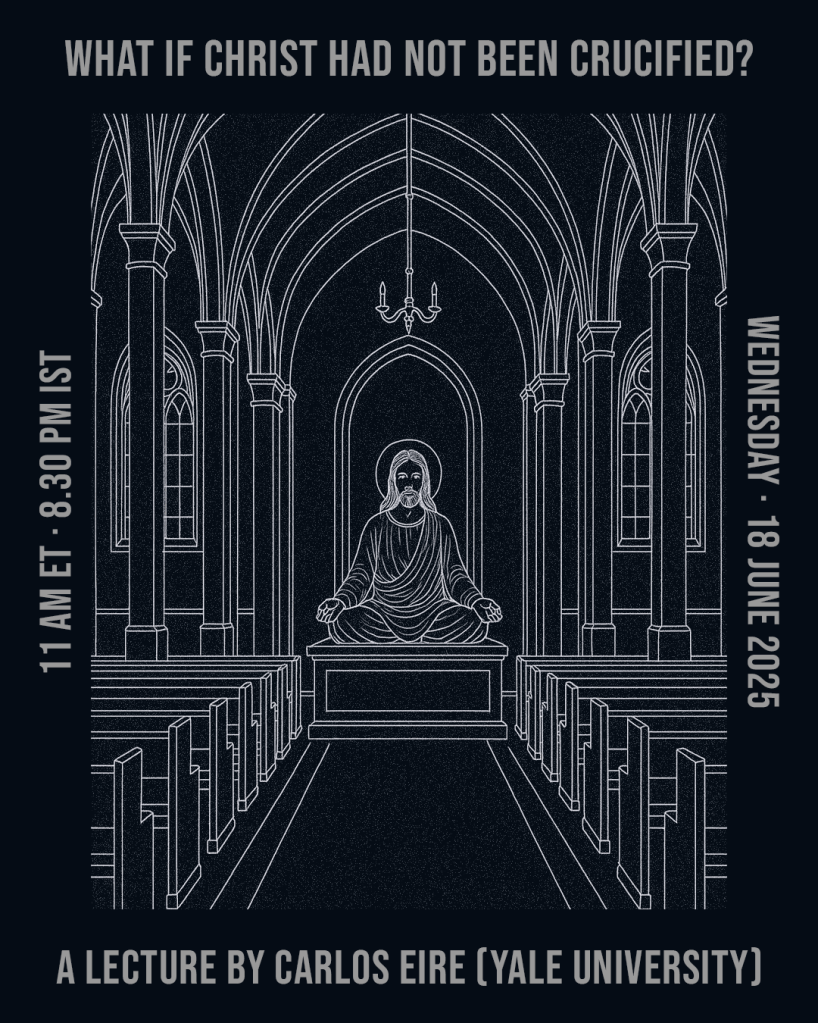
It is the fate of rockstars and messiahs to die young. If Jesus lived to be ninety, what would Christianity have looked like? Could an arthritic or decrepit messiah become the face of a world religion? And what would Judaism look like today, or Islam, had Christ not been deemed a divine entity but merely a great teacher? All of this builds up to a larger question: How do we write a counterfactual history of religion? For what is ‘factual’ in something that necessarily rests on belief? What is a ‘fact’ in theology? Carlos Eire of Yale proffers an answer in his ‘minimal rewrites’ of the two events central to the development of the modern West—the Crucifixion and the English Reformation. To discuss ‘the challenges and rewards of counterfactual history and its conceptual twin, the history of the impossible’, we were delighted to welcome Professor Eire.
Carlos Eire’s latest is They Flew: A History of the Impossible (Yale, 2023):
Accounts of seemingly impossible phenomena abounded in the early modern era—tales of levitation, bilocation, and witchcraft—even as skepticism, atheism, and empirical science were starting to supplant religious belief in the paranormal. In this book, Carlos M. N. Eire explores how a culture increasingly devoted to scientific thinking grappled with events deemed impossible by its leading intellectuals. The questions he explores—such as why and how “impossibility” is determined by cultural contexts, and whether there is more to reality than meets the eye or can be observed by science—have resonance and lessons for our time.
 Fact or Value