If you asked a botanist in the eighteenth century to draw you a rose, he would have produced a flawless illustration of the flower. This perfect specimen would combine petals, pistils, stamens and stem in a way no single rose could replicate. Nor is the botanist interested in sketching a particular rose; he is in the business of making idealized images.
The same botanist in the nineteenth century would, however, shy away from this and instead offer you something more ‘objective’—a set of photographs of roses, however imperfect, irregular and different from one another they may be. The task of determining what was perfect—or even if such a concept applied—would be left to you, the viewer.
It is in this context, argues Lorraine Daston, that the ideal of objectivity emerges: a weariness towards generalizations, a reluctance to idealize nature, a commitment to represent the world as it is.
To be objective, then, is not necessarily to be scientific, accurate, precise or certain. Rather, objectivity, Daston argues, is one among many epistemic virtues that scientists—natural and social—strive to balance. Objectivity, both the word and the ideal, is a recent invention (or discovery), some two hundred years old. And yet it feels as though it has always been with us: in the minds of Thucydides and Descartes, in the methods of Newton and Boyle and in the sketches of Masaccio and Brunelleschi.
To discuss the history of objectivity, we were honoured to welcome Lorraine Daston, director emerita at the Max Planck Institute for the History of Science, Berlin, and visiting professor in the John U. Nef Committee on Social Thought at the University of Chicago.
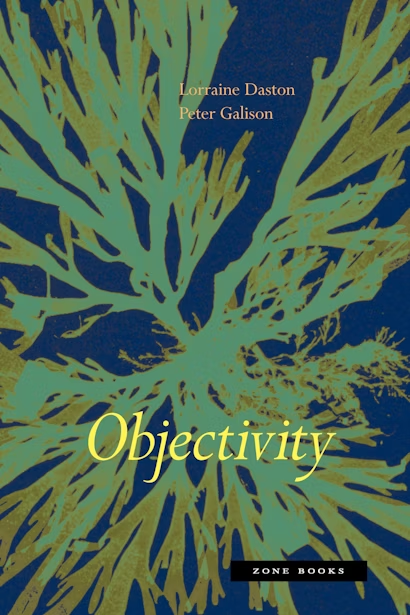
Objectivity has a history, and it is full of surprises. In Objectivity, Lorraine Daston and Peter Galison chart the emergence of objectivity in the mid-nineteenth-century sciences — and show how the concept differs from alternatives, truth-to-nature and trained judgment. This is a story of lofty epistemic ideals fused with workaday practices in the making of scientific images.
From the eighteenth through the early twenty-first centuries, the images that reveal the deepest commitments of the empirical sciences — from anatomy to crystallography — are those featured in scientific atlases: the compendia that teach practitioners of a discipline what is worth looking at and how to look at it. Atlas images define the working objects of the sciences of the eye: snowflakes, galaxies, skeletons, even elementary particles.
Galison and Daston use atlas images to uncover a hidden history of scientific objectivity and its rivals. Whether an atlas maker idealizes an image to capture the essentials in the name of truth-to-nature or refuses to erase even the most incidental detail in the name of objectivity or highlights patterns in the name of trained judgment is a decision enforced by an ethos as well as by an epistemology.
As Daston and Galison argue, atlases shape the subjects as well as the objects of science. To pursue objectivity — or truth-to-nature or trained judgment — is simultaneously to cultivate a distinctive scientific self wherein knowing and knower converge. Moreover, the very point at which they visibly converge is in the very act of seeing not as a separate individual but as a member of a particular scientific community. Embedded in the atlas image, therefore, are the traces of consequential choices about knowledge, persona, and collective sight. Objectivity is a book addressed to any one interested in the elusive and crucial notion of objectivity — and in what it means to peer into the world scientifically.
Lorraine Daston is director emerita at the Max Planck Institute for the History of Science, Berlin, and visiting professor in the John U. Nef Committee on Social Thought at the University of Chicago. She is the author of Rivals: How Scientists Learned to Cooperate (2023), Rules: A Short History of What We Live By (2022), Against Nature (2019), (with Peter Galison) Objectivity (2007), (with Katharine Park) Wonders and the the Order of Nature, 1150-1750 (1998) and Classical Probability in the Enlightenment (1988).
 Fact or Value