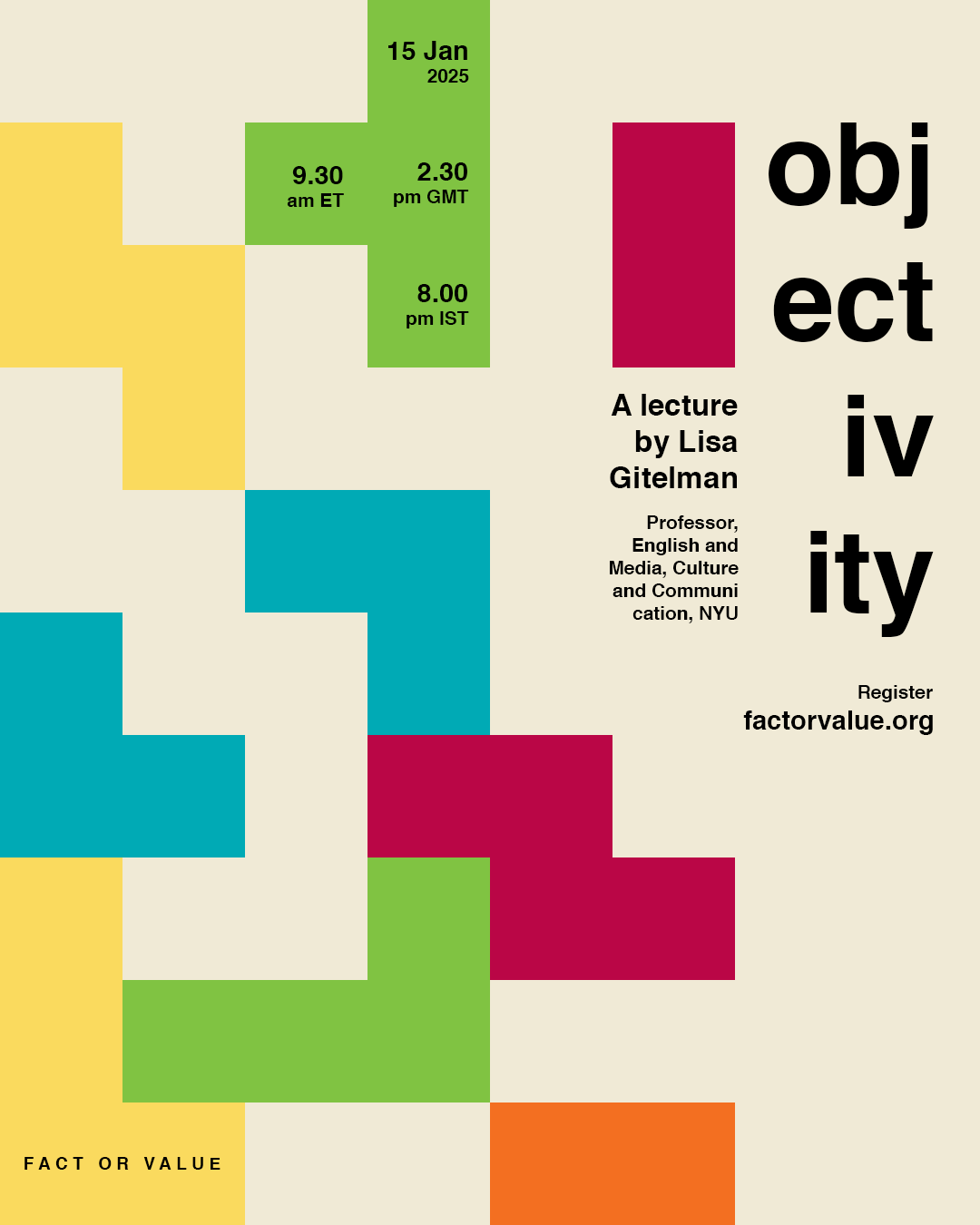

Bias. Spin. Propaganda. Hype. Fake news. These pejoratives are familiar to citizens of the twenty-first century, and by implication they privilege the same alternative: objectivity. Objectivity is a concept—or an ideal—that frames our understanding of pursuits as diverse as politics, journalism, and science, all realms in which we hope to be able to discern the right, the true, the safe, and the real. But what is objectivity? Whose discernment counts as objective? How can we tell? Questions like these ask us to consider not only what we know but also how we know it.
The conditions of producing, possessing, and assessing knowledge turn out to be remarkably available to change. In other words, objectivity has a history. This reading circle considers objectivity within and against the Western intellectual tradition. By considering selected episodes in its emergence, both ancient and modern, we will ask how thinkers have thought about knowing: What routes have been available to the pursuit of certainty? What standards exist or have existed for knowledge about the past, about the self or about others, and about the world around us? Is it possible that this century will involve new forms of objectivity? We explored questions like these by drawing on works of philosophy, history, criticism and the arts.
Lisa Gitelman a professor of English at NYU. She is a media historian whose research concerns American print culture, techniques of inscription, and the new media of yesterday and today. She is particularly concerned with tracing the patterns according to which new media become meaningful within and against the contexts of older media. Her most recent book is entitled Paper Knowledge: Toward a Media History of Documents and was published by Duke in 2014.
Text taken from Prof. Gitelman’s NYU course description.
The talk was preceded by an optional reading session based on Professor Gitelman’s NYU course on Objectivity—
Reading List
- PLATO, Meno.
- THUCYDIDES, The Peloponnesian War, Book 1.
- LEON BATTISTA ALBERTI, On Painting.
- MONTAIGNE, ‘On idleness’, ‘That it is folly to measure truth and error’ and ‘On cannibals’.
- Philosophical Transactions of the Royal Society, Volume 1, Number 1 (1665)
- Presentist Interlude: ‘Ground-Zero Empiricism’ by Lorraine Daston and ‘Beware the Magic of Metrics’ by Arjun Appadurai and Paula Kift.
- First few chapters from W. E. B. Du Bois, The Philadelphia Negro and The Souls of Black Folk.
- FREUD, ‘A Note Upon the Mystic Writing Pad’.
- BORGES, ‘Funes, the Memorious.’
- LOOS, ‘Ornament and Crime’.
- NAKAZAWA, I Saw It.
 Fact or Value