“…even in this age of information, there are thousands in the lower classes who cannot read.”
This is not from Paul Duguid’s The Social Life of Information. This is from a 1778 essay by the wonderfully named Englishman, Vicesimus Knox. For Knox, it was the printing press, the library and the exponentially growing access to books that made his age the “Age of Information”
Do we, in our time, live in the age of information? Or has every age felt overwhelmed by a tidal wave of new knowledge?
If both the 18th and the 21st century can lay claim to the title, what is “information” at all? This is what Duguid invites us to consider in this retrospective. He situates the concept within epistemology, examining how information–ostensibly sanitised and quantified–exists inseparably tied to institutions and groups. The social context blurs the line between constraints and resources, at once hindering the use of information and making possible its use in the first place.
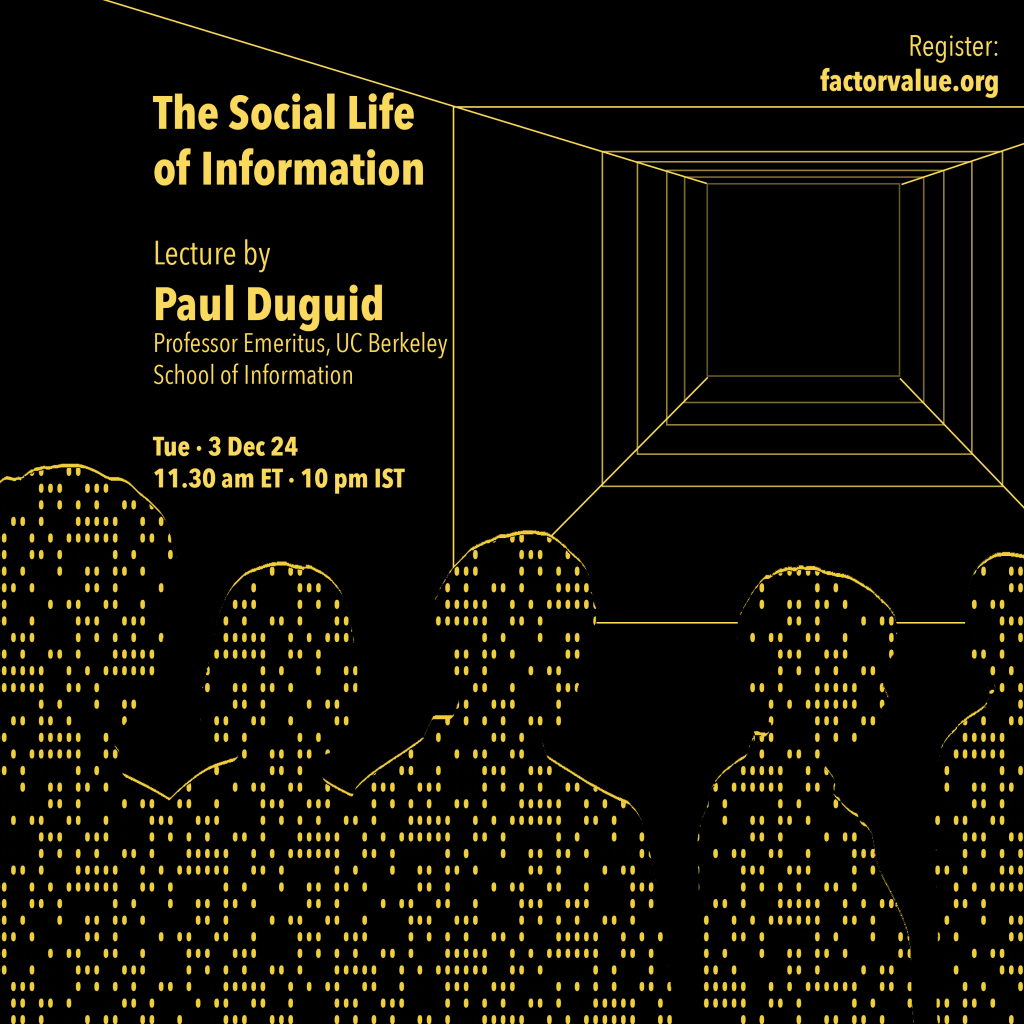
In this talk, Professor Duguid will set The Social Life of Information (2000) in the historical context of the growing recognition of an “information age” or “information society” and the geographical context of Silicon Valley, where the authors worked as the book was written. In the process, it will also seek to set the concept of “information” in the context of epistemology and notions of facts, value, and truth.
Paul Duguid is professor emeritus at the School of Information, University of California, Berkeley. He is the co-author of A Social History of Information and the co-editor of Information: A Historical Companion.


 Fact or Value